


The coverage of this year’s federal Medicaid actions uses three words almost interchangeably. Funds were deferred. Payments were suspended. Amounts may be disallowed. In the headlines they blur into one idea, the government held the money, and for a general reader that is close enough.
For anyone accountable for a program, it is not close enough. These are three different machines, with different triggers, different clocks, and different burdens of proof. The letter that names one of them is telling you exactly what is being demanded, from whom, and how fast. Most organizations learn the differences in the week it stops being academic. This is the short version, in advance.
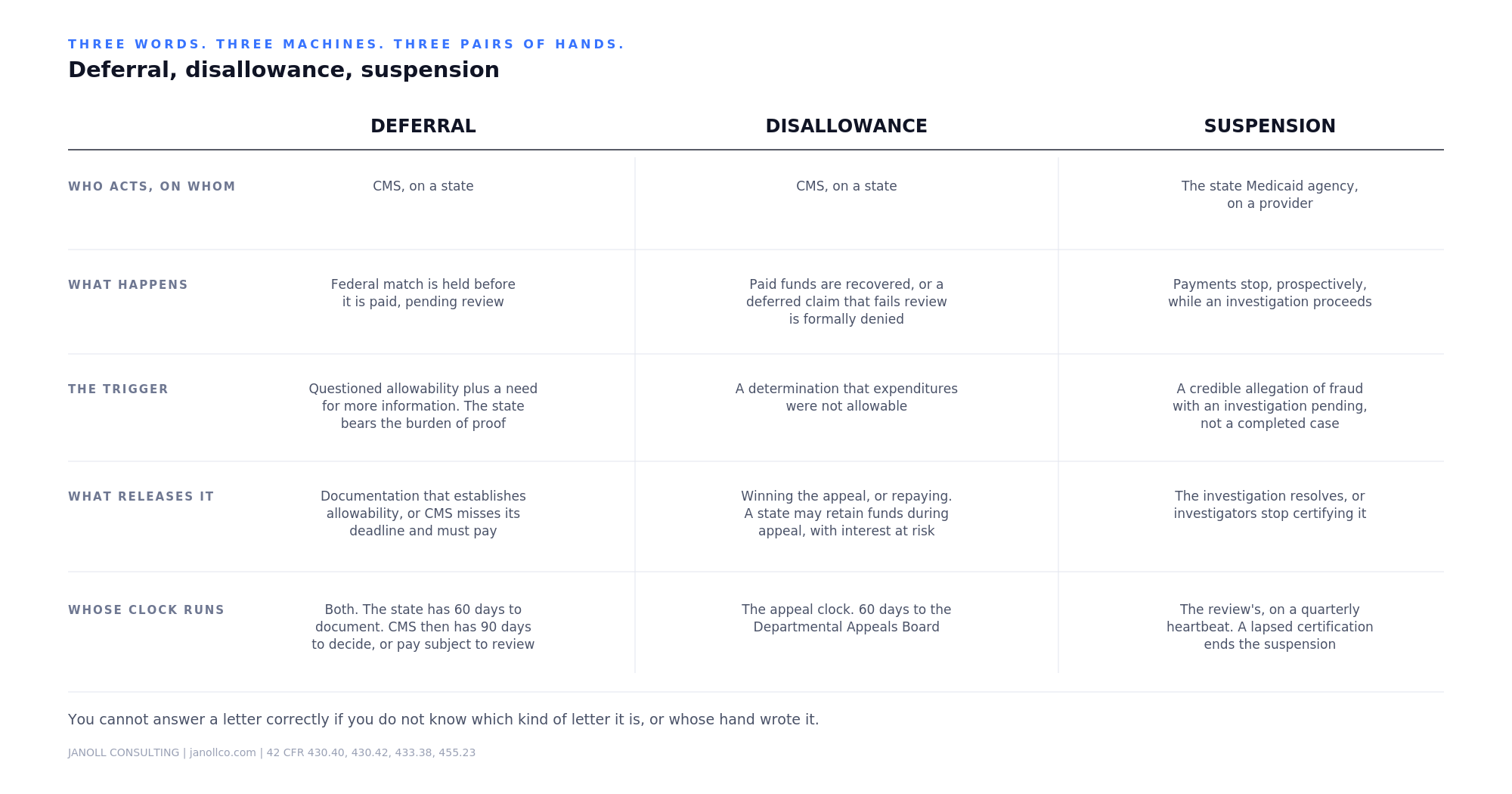
A deferral holds money before it is paid. The federal government defers its share, the match, on expenditures whose allowability it questions and needs more information about, and the regulation is explicit about who carries the weight: the state bears the burden of establishing that a deferred claim was allowable. Nothing has been taken back, because nothing was handed over. The burden is documentary and immediate, produce the record within 60 days, while the hole sits on the program’s books. But the machine has a counterweight almost nobody mentions: once the documentation is in readily reviewable form, CMS has 90 days to decide, and if it cannot complete the review in time, it must pay the claim, subject to later determination. Both sides are on clocks. February’s Minnesota action, May’s $1.34 billion California action, and July’s billion-dollar announcement were deferrals, and the reviewing posture behind them is the story of 2026: records read by people looking for reasons to hold, with the deadlines doing the negotiating.
A disallowance is the formal denial, and it cuts both directions. Sometimes it claws back money already paid. Just as often it is the death of a deferred claim, a denial of match the state never received. Either way it arrives with an appeal path, formal, slow, and evidentiary: sixty days to the Departmental Appeals Board, and a cash-flow decision most coverage never mentions, because a state can elect to retain the disputed funds while it fights, by notifying CMS in writing within sixty days, with interest accruing against it if it loses. The fight itself is retrospective, and it is decided almost entirely on the written record that existed when the claim was made. A program cannot improve its position after the fact. Whatever documentation was built at the time of the work is the case. Whatever was not built is the exposure.
A suspension stops payments on a credible allegation, and here the hands change. This is not CMS acting on a state. It is the state Medicaid agency acting on a provider, required to suspend payments when there is a credible allegation of fraud with an investigation pending, an allegation with indicia of reliability, not a completed case. It is prospective, it is blunt, and it is not open-ended: the suspension runs on a quarterly heartbeat, with the state required to certify that the matter remains under active investigation, and a lapsed certification ends it. If you administer a program, this is the letter you send. If you bill one, it is the letter you dread. Same word in the headlines, opposite sides of the table.
Put the three side by side and two patterns emerge. The first is that these letters do not even come from the same hands: deferral and disallowance run federal to state, suspension runs state to provider, which means knowing which letter you received includes knowing whose signature is on it and which seat you occupy in the chain. The second pattern matters more. In every mechanism, the deciding variable is the same. Not the size of the questioned amount. Not the vigor of the response. The record. A deferral is answered with documentation or it is not answered. A disallowance appeal is won on the contemporaneous record or lost on its absence. A suspension is imposed, certified, and resolved on evidence. Three machines, three pairs of hands, one fuel.
Which is why the practical takeaway is not a glossary. It is a posture. The organizations that move through these events fastest are the ones whose records were built at the time of the work, to a standard that survives a hostile reader, because every one of these letters is, underneath the terminology, the same demand: prove it, from the written record, on our timeline. You cannot answer a letter correctly if you do not know which kind of letter it is. And you cannot answer any of them well if the record was not built before it arrived.
The full argument, including what a defensible posture requires before the letter comes, is in our brief, After the Deferral. Request it at janollco.com/after-the-deferral.
Leave a Reply